
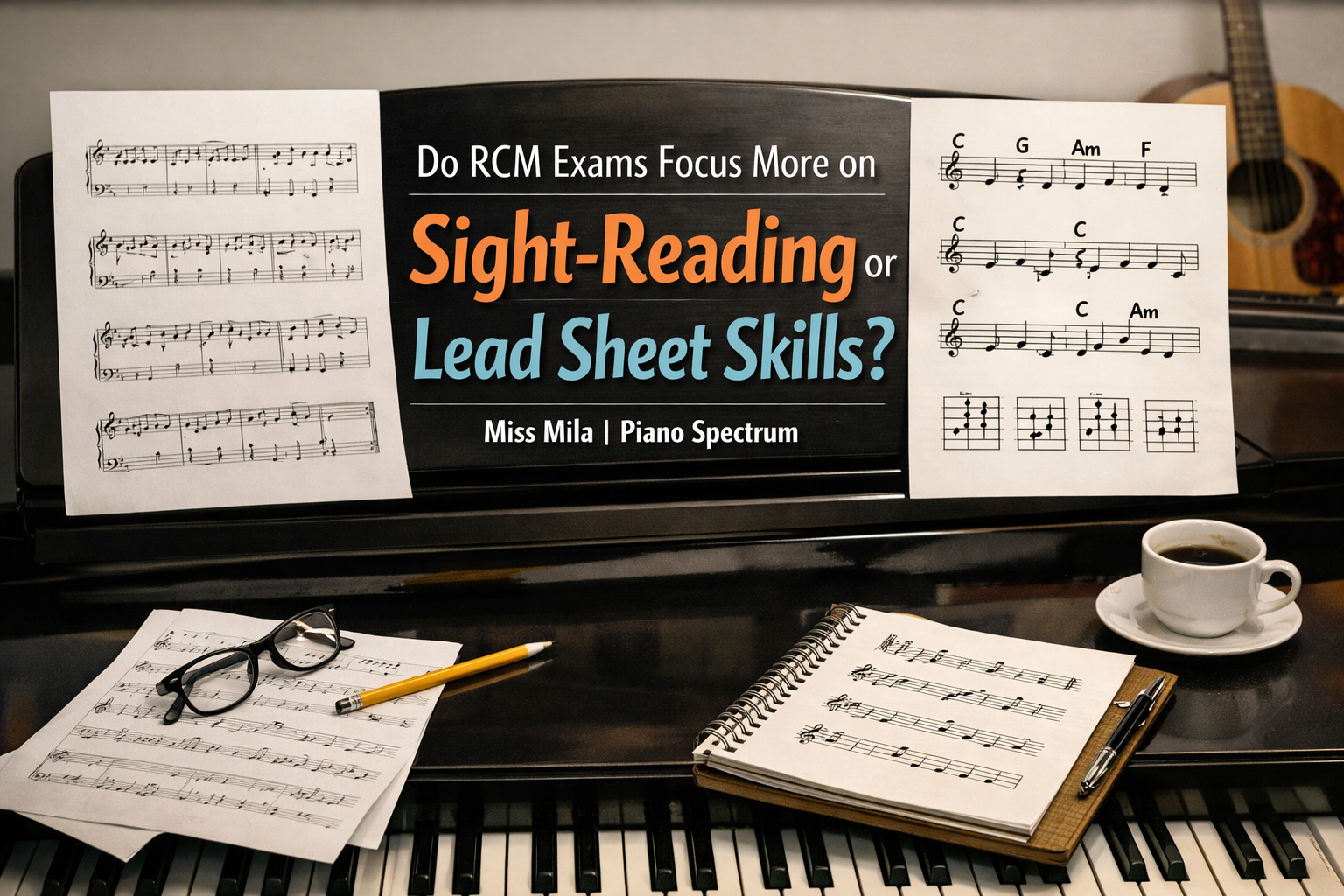
Learning piano through the Royal Conservatory of Music system can feel structured and rewarding, but also a little confusing when it comes to expectations. One of the most common questions students and parents ask is simple: do RCM exams focus more on sight-reading or lead sheet skills?
If you are preparing with Miss Mila at Piano Spectrum or working through Levels 1 to 8 on your own, understanding this balance can directly impact your exam results and long term musicianship.
Let’s break it down in a clear, practical, and human way so you know exactly what to focus on.
Understanding the Core of RCM Piano Exams
The Royal Conservatory of Music builds its piano program around well rounded musicianship. This means students are not only judged on how well they play memorized pieces but also on how they read, interpret, and understand music.
Each exam typically includes:
- Repertoire performance
- Technical requirements
- Ear tests
- Sight-reading
- Rhythm clapping or tapping
Notice something important here. Sight-reading is officially part of the exam. Lead sheet playing is not explicitly listed in lower to intermediate levels.
That alone gives us a strong clue.
What Is Sight-Reading in RCM?
Sight-reading is the ability to play a piece of music you have never seen before. In RCM exams, students are given a short excerpt and a brief moment to look at it before playing.
This tests:
- Note recognition
- Rhythm accuracy
- Hand coordination
- Musical flow under pressure
Sight-reading is not about perfection. It is about continuity and musical understanding.
At Levels 1 to 4, sight-reading is quite simple with basic rhythms and positions. By Levels 5 to 8, it becomes more complex with varied keys, rhythms, and hand movements.
What Are Lead Sheet Skills?
Lead sheet playing involves reading a melody line with chord symbols and improvising or accompanying based on those chords.
This includes:
- Chord recognition
- Harmonic understanding
- Improvisation
- Creativity
Lead sheet skills are widely used in pop, jazz, and contemporary music. However, they are not a core requirement in traditional RCM classical exams at lower and mid levels.
So Which One Matters More in RCM Exams?
Here is the honest answer.
RCM exams focus significantly more on sight-reading than lead sheet skills.
Sight-reading is tested directly and contributes to your final mark. Lead sheet playing is not formally assessed in most early and intermediate levels.
That said, this does not mean lead sheet skills are unimportant.
In fact, students who develop strong lead sheet understanding often improve faster in overall musicianship.
Why Sight-Reading Is So Important in RCM
There are three main reasons sight-reading carries more weight.
1. It reflects real musicianship
Anyone can memorize a piece with enough practice. Sight-reading shows how well you actually understand music.
2. It builds independence
Students who sight-read well learn new pieces faster and with less frustration.
3. It is objectively testable
Examiners can easily evaluate sight-reading performance in a standardized way.
Where Lead Sheet Skills Fit In
Even though lead sheet skills are not formally tested, they are quietly powerful.
Students who practice lead sheets often:
- Understand chord progressions better
- Play with more expression
- Adapt quickly to new styles
- Develop stronger listening skills
At Piano Spectrum, Miss Mila often integrates elements of lead sheet thinking into lessons even for RCM students. This creates a more balanced musician rather than someone who only plays what is written.
RCM Lead Sheet Tips Versus Sight-Reading: What Should You Focus On?
Let’s directly address the keyword topic: RCM Lead Sheet tips versus sight-reading.
If your goal is exam success, your priority should be:
Focus 70 percent on sight-reading
Practice daily short exercises
Work on rhythm consistency
Train your eyes to read ahead
Focus 30 percent on lead sheet skills
Learn basic chords
Practice simple accompaniment patterns
Try playing melodies with chord support
This combination gives you the best of both worlds.
Practical Sight-Reading Strategies for RCM Students
If you want to improve quickly, try these methods.
Practice every day for 5 minutes
Consistency matters more than duration.
Do not stop when you make mistakes
Keep the rhythm going. Examiners care more about flow than perfection.
Scan before playing
Look for:
- Key signature
- Time signature
- Starting position
- Rhythmic patterns
Use level appropriate books
Do not jump too far ahead. Build confidence gradually.
Smart Lead Sheet Tips That Actually Help RCM Students
Even though the focus is on sight-reading, these lead sheet strategies can enhance your playing.
Learn chord patterns in common keys
Start with C major, G major, and F major.
Practice broken chords and simple rhythms
This builds coordination and musical feel.
Play by ear occasionally
Try to match melodies without sheet music.
Understand harmony, not just notes
This helps you anticipate what comes next when sight-reading.
How Miss Mila Teaches the Balance
At Piano Spectrum, Miss Mila does not treat sight-reading and lead sheet skills as separate worlds.
Instead, lessons are structured to:
- Strengthen reading skills through daily exercises
- Introduce chord awareness early
- Encourage musical expression beyond the page
This approach helps students not only pass exams but also enjoy playing piano long after.
Common Mistakes Students Make
Ignoring sight-reading until exam time
This leads to panic and poor performance.
Over memorizing pieces
Students become dependent on memory instead of reading.
Avoiding lead sheet practice completely
This limits musical growth and creativity.
Practicing sight-reading incorrectly
Stopping frequently or repeating the same piece defeats the purpose.
What Happens at Higher Levels?
As students move beyond Level 8, musical expectations grow.
While formal lead sheet testing may still be limited, musicianship expectations expand to include:
- Harmonic understanding
- Interpretation
- Style awareness
Students who already have some lead sheet experience tend to excel more naturally.
Parent Perspective: What Should You Encourage?
If you are a parent guiding your child:
- Encourage daily sight-reading practice
- Support a structured lesson plan
- Allow creative exploration through chords and improvisation
- Avoid focusing only on exam scores
A balanced approach leads to better long term results.
Final Verdict: Sight-Reading vs Lead Sheet Skills
If we compare RCM Lead Sheet tips versus sight-reading directly, the answer is clear.
Sight-reading is the dominant skill in exams. It is tested, graded, and essential for success.
Lead sheet skills are not the main focus in exams but are incredibly valuable for building a complete musician.
The smartest students do not choose one over the other. They develop both, with a stronger emphasis on sight-reading for exam preparation.
FAQ Section
Do RCM exams include lead sheet playing?
No, most early to intermediate RCM exams do not formally test lead sheet playing. The focus is on classical reading and performance skills.
How much is sight-reading worth in RCM exams?
Sight-reading is a graded component and contributes to your overall exam score. While it may not be the largest section, it can significantly affect your final result.
Can lead sheet practice improve sight-reading?
Yes, understanding chords and harmony through lead sheets can help you recognize patterns faster when sight-reading.
How often should I practice sight-reading?
Daily practice of 5 to 10 minutes is ideal. Consistency is more important than long sessions.
Is it possible to pass RCM exams with weak sight-reading?
It is possible, but risky. Weak sight-reading can lower your marks and affect your overall performance impression.
Closing Thoughts
Mastering RCM Lead Sheet tips versus sight-reading is not about choosing one skill over the other. It is about understanding priorities and building a strong musical foundation.
If your goal is to succeed in RCM exams, sight-reading should be your daily habit. If your goal is to become a confident and expressive pianist, lead sheet skills should also be part of your journey.
The best results come from balance, guided learning, and consistent practice.
Want to boost your RCM exam scores faster while actually enjoying the process? Start learning with Miss Mila at Piano Spectrum and transform the way you read, play, and understand music today.